
By Jacob Cameron
The works of William Shakespeare are timeless. With some of his work being adapted time and time again in film history. Throne of Blood is Akira Kurosawa’s take on MacBeth. Taking the story from Scotland to Japan. And in turn, making a truly great Shakespeare adaptation and film as a whole.
The film tells the story of Samurai warriors Taketomi Washizu and Yoshiteru Miki. The two have just won a battle against the enemies of their lord and are returning home. While traveling through a forest, they encounter a spirit who tells their futures. Miki is set to become lord of the first fort, Washizu will take over that position, followed by Miki’s son. The prophecy shakes the two to their core. The remainder of the film is a domino effect that unfolds the prophecy as foretold.

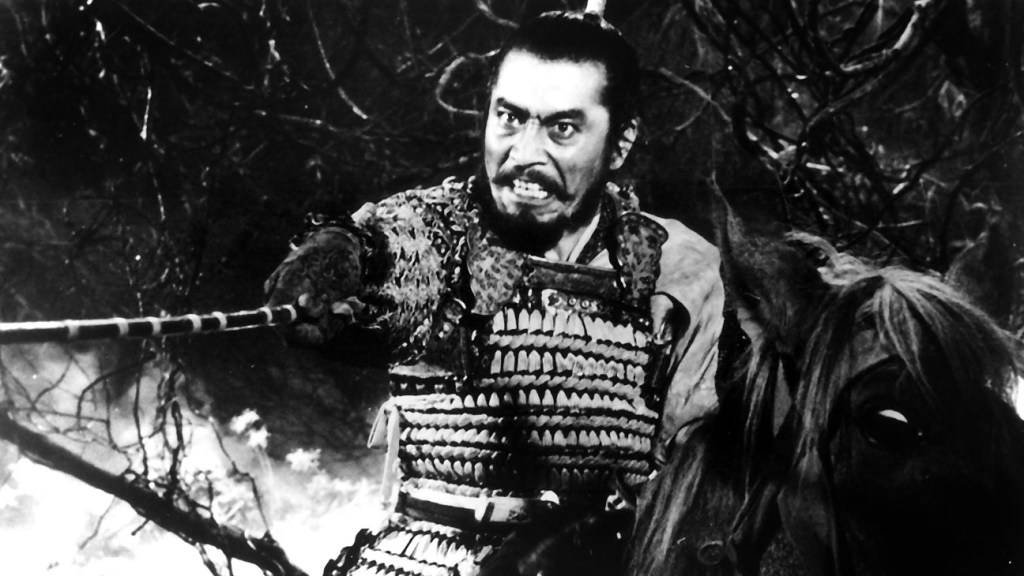
At the risk of sounding repetitive, Toshiro Mifune is excellent as the lead Washizu. Mifune was great at playing very deranged characters. Here, he starts out as a disciplined samurai warrior dedicated to his lord. Upon hearing this prophecy and with further motivation from his wife Asaji, he slowly becomes drunk with power. His ambition blinds him from his better judgment, and it leads to his downfall.
Mentions should be made of Isuzu Yamada and Akira Kubo as Asaji Washitazu and Yoshiteru Miki, respectively. Asaji is the catalyst for her husband’s power grab and downfall. With Miki serving as a boon to Washizu both in the physical and supernatural realm. One of my favorite scenes in the movie is Washizu, drunk on Sake, swinging wildly at the ghost of Miki with his sword. Scaring the warriors under his command and Asaji saying, “You, who would soon rule the world, allow a ghost to frighten you.”

On the production side, this film was shot on the slopes of Mt. Fuji. Kurosawa wanted the film to achieve a foggy look, and it was a mission accomplished. The fog surrounding many scenes makes it feel like it takes place in another realm. There are elements of mystery and danger prevalent throughout the film. With action sequences that are stunning and a jaw-dropping conclusion.
In doing research, Toho initially wanted Ishiro Honda, director of 1954’s Gojira, to direct this film. It was decided that, due to the scope of the film, it was Kurosawa or no one. With all due respect to the immense talents of Honda, Kurosawa brings a passion to this that can not be ignored. Kurosawa was a huge fan of MacBeth and wanted to make a version of it for years. It was only Orson Welles’ adaptation in 1948 that would cause Kurosawa to delay making the project for several years.

At the end of the day, this is not my overall favorite of Kurosawa’s films that I have covered. But make no mistake about it, this is still an immense achievement. It’s a dark and powerful and fitting adaptation of a literary classic. You don’t have to be a Shakespearean scholar to appreciate this film.
5 stars

 From the Fourth Row!
Leave a comment