
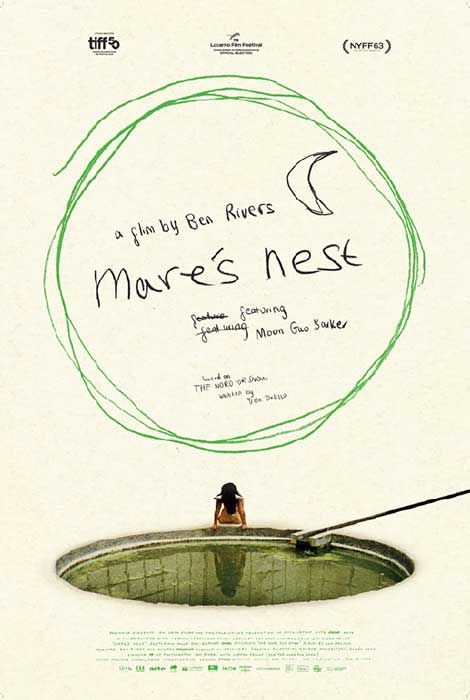
By Kyle Flynn
Mare’s Nest is the most recent undertaking from experimental filmmaker Ben Rivers, an adaptation of the one-act play written by Don DeLillo, The Word of Snow. The film follows a young child appropriately named Moon (the child actor’s name, Moon Guo Barker), who travels and interacts with this world without adults.
This was my first time watching anything from Ben Rivers or any type of creative endeavor from the filmmaker. When adapting someone like DeLillo—whose writing is famously opaque and intellectually dense—I was impressed by how confidently Rivers frames the story. Within the first 20 minutes of the film, a long take of Moon speaking directly to the camera with dialogue I can only assume took much practice and rehearsal (and if it didn’t, it only makes it more impressive) as it brings you into the world that Rivers wants you, the audience, to buy into very quickly.

The screen presence commanded by Moon stunned me. For a first performance from a young actor, it is not only a great effort but a strong performance. Child performances can often feel forced or overly rehearsed, but here, the acting feels hypnotic and raw, even in moments where the dialogue is conceptually challenging. The material covered in the film is not only esoteric, dense, but also material I would not have a reasonable expectation for children to comprehend, so by the end, I can’t help not to be impressed with the performances we see in the movie.
The visual presentation of the movie is held to a high standard. The cinematography is amongst the best I have seen this year. It stimulates the senses in a way that a feel is missing from a lot of modern films—both mainstream and experimental. Cinematographer Levi Giles captures these landscapes in wide, still frames that leave the viewer space to reflect. Some shots are done on digital, and some shots are done on film; There are scenes with this stark color used and scenes with eye-popping black and white.
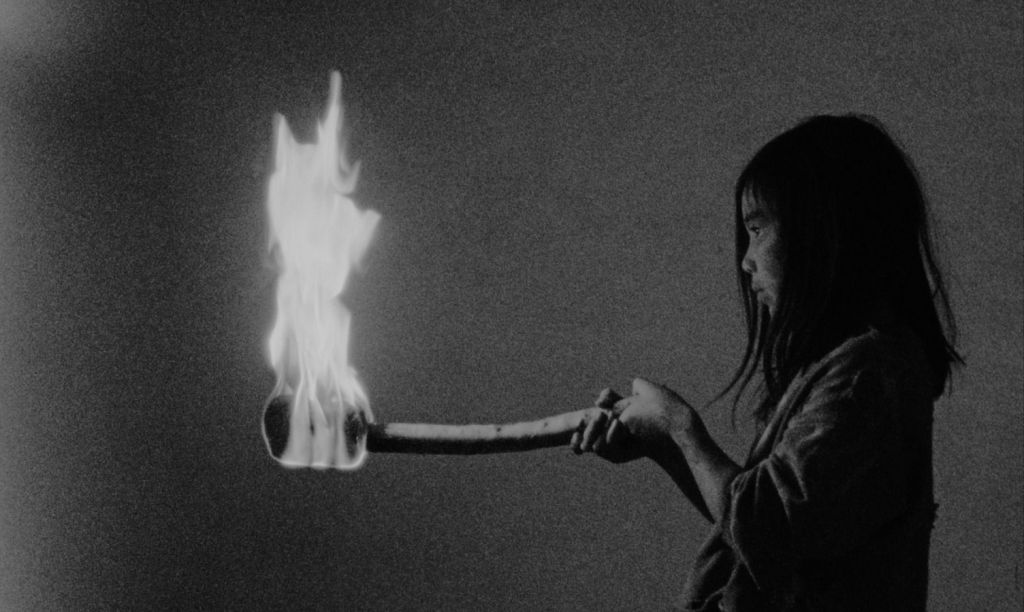
Arguably, where the film falls flat for me is with the screenplay itself. In a sense, this is clearly intentional on behalf of Rivers to have this disjointed feeling and narrative laid out with the different segments of the film with different tonal and visual styles. I question if my lack of familiarity with DeLillo (I have only read White Noise or Rivers was a hindrance to my enjoyment of the film. Some segments shine through as major highlights (both the cold open and the scholar scene come to mind), but many just felt like they droned on.
By the end, Mare’s Nest doesn’t offer answers—But the questions it provokes left me sitting after the experince (The final song quite fittingly is ‘Too Many Questions’ by Frustration, a song I had never heard before until watching this movie). It also left me with a lingering feeling of awe, confusion, and curiosity. And maybe that’s exactly what it means to exist in this world.

Writer’s Note: It feels somewhat arbitrary to give a film like this a numerical rating, but my editor will force me to.
3 ½ stars

 From the Fourth Row!
Leave a comment