By Jacob Cameron
“I am lost…”
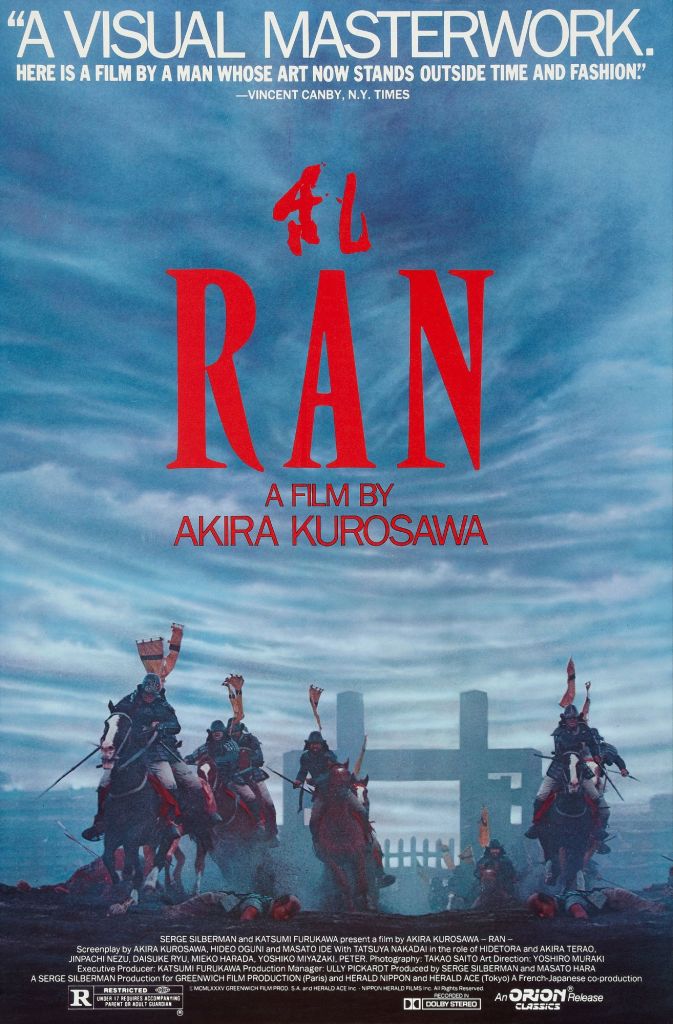
This quote from Hidetora Ichimonji, the main character of 1985’s Ran, serves as but a taste of the chaos of the film. Ran is Akira Kurosawa’s take on William Shakespeare’s King Lear. Ran serves as the end of an era; this would be the last “epic” or Kurosawa’s career. Kurosawa went through a great deal while making this film as his wife would pass away during filming. But Ran is the only film for which Kurosawa was nominated for Best Director at the academy awards. It was a nomination that was well deserved.
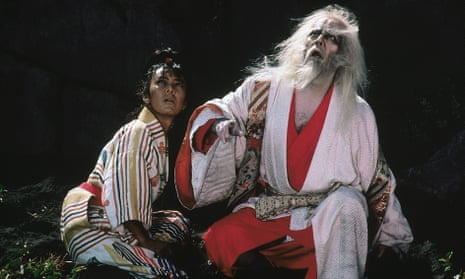
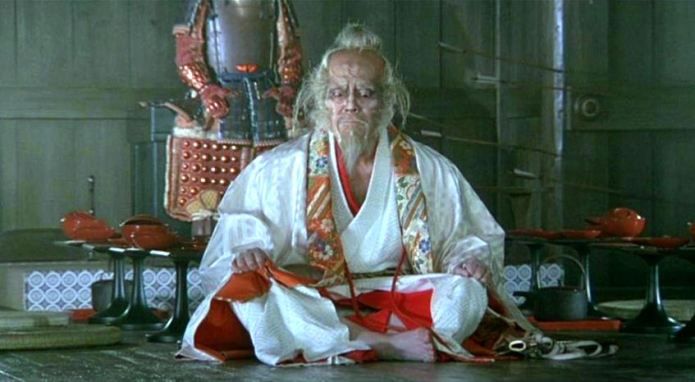
Ran tells the story of Hidetora Ichimonji, played by Tetsuya Nakadi, a warlord who is elderly. He divides his kingdom between his three sons: Taro, Jiro, and Saburo. Resentment grows between the house of Ichimonji, which boils over into jealousy, score-settling, and violence. Violence at such a level that causes Hidetora to go insane. And the fall of the house in a hail of arrows and blood.
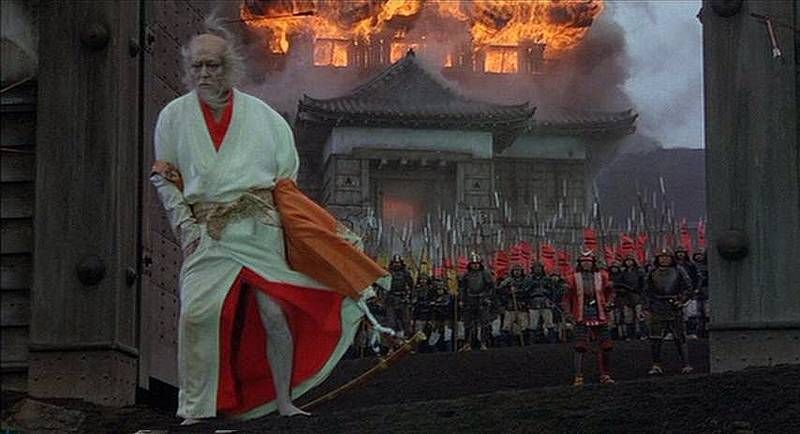
Kurosawa’s films have never lacked in the visuals. With this in mind, this is one of the best looking film of his career. Kurosawa uses color in this film in such a way that it tells the story more than the dialogue at times. The use of the color red specifically is striking. The red, set against the black landscape of Mt. Fuji, tells more emotion than a thousand words.
Kurosawa always knew how to make epic battles in his films. There is no more epic than the attack on Hidetora’s castle. Taro and Jiro combine armies to take out their father once and for all. There is no dialogue, a haunting score, and death as far as the eye can see. It becomes too much for Hidetora, who loses his sanity as his castle burns around him. It is a sequence that needs to be seen to be believed.

The film is not just the battles. This movie is also a family tragedy that is a genuine tragedy. It’s the furthest thing from a melodrama. Saburo gets banished for speaking against his father and Taro is convinced to initiate a power grab by his wife. Taro’s wife’s family was killed by Hidetora many years ago and has held a grudge ever since.
Everyone in this clan has made mistakes and holds grudges against the other. The clan is firmly living in a “must-lose” situation. Violence is the only way out for this clan and the violence ultimately destroys the clan beyond repair. Even though this was not a direct adaptation of King Lear, the film does an excellent job of capturing the spirit of the tragedy.
Ultimately, this movie is a genuine masterpiece. It’s a feast for the eyes, it’s a captivating story, it is all that and more.
5 stars
This is my last article for A Very Kurosawa Summer. I want to thank Dan and From the Fourth Row for the opportunity to review these films. It was a great experience.

 From the Fourth Row!
Leave a comment