

By Kyle Flynn
What makes art worthwhile? What makes art meaningful? If I were ever asked to give an example of a piece of art, I believe is “worthwhile” (whatever it truly means), I likely would not take the question seriously, but somehow think far too hard about it, ending in me citing Sarah Kane’s play ‘4:48 Psychosis’, Stevie Wonder’s album ‘Song’s To The Key of Life’, and Jacque Demy’s French New Wave Masterpiece ‘The Umbrella’s of Cherboug.’ I do hold almost a religious-like reverence towards the French New Wave. Its impact on cinema and the unbridled quality of so many of the films produced make all cinema fans intrigued by the movement.
Linklater, a filmmaker clearly influenced, if not directly by the French New Wave, certainly captures the bravado reflected in his filmmaking. His newest film, Nouvelle Vague, is about French auteur Jean-Luc Godard making his first film, Breathless. Breathless to me would not be at the top of my Godard Rankings, nor would I consider it one of the top 10 films to come out of the movement. That being said, I do still love Breathless.
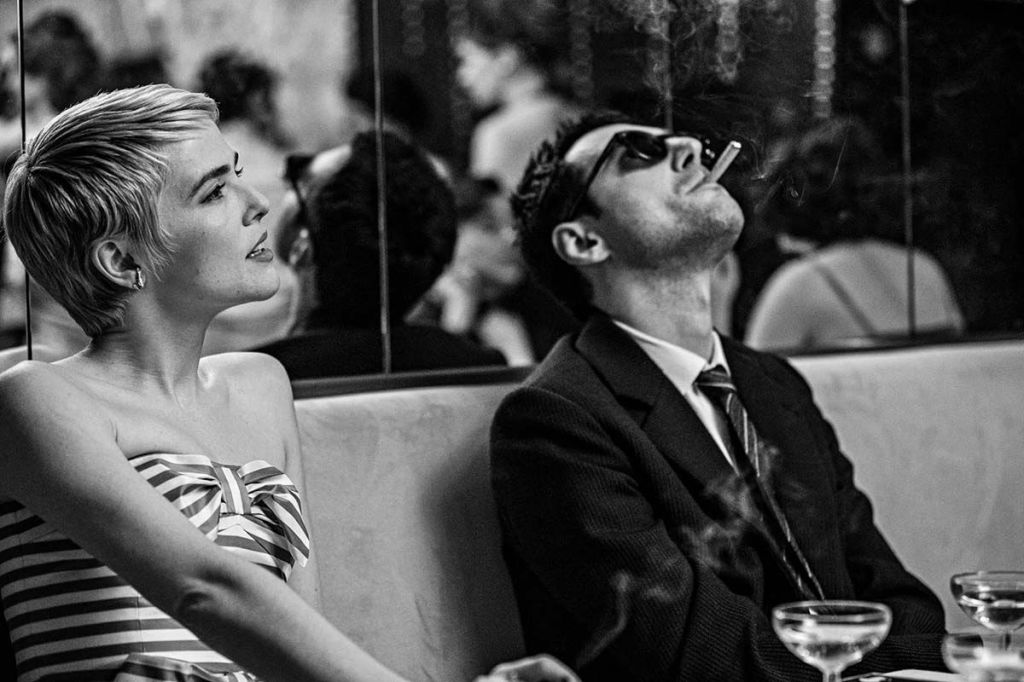
Going into Nouvelle Vague, I think my biggest fear was Linklater’s not understanding or capturing what makes Breathless so special. I believe he finds that within the film, but I do not think Linklater even came close to capturing the New Wave meaningfully. Assuming part of the film’s thesis is viewing the New Wave through the eyes of a young Godard, I would say it fails. At no point do the investigations into Godard’s inner psychology go deeper than the initial dread of never getting the opportunity to fulfill your potential (in Godard’s case, to be more than a critic and to create ‘his’ film).
As a hangout movie, it is a laid-back enough watch to sit back and laugh. Still, Linklater, arguably synonymous with the hangout movie genre, has so many better hangout movies that I could never imagine a non-cinephile choosing to rewatch Nouvelle Vague over Dazed and Confused. Every passing minute, I hoped for more to come out of it, but it never materialized; going from scene to scene, taking place mainly within the confines of the shoot of Breathless, feels endless and repetitive by Day 6 or 7.
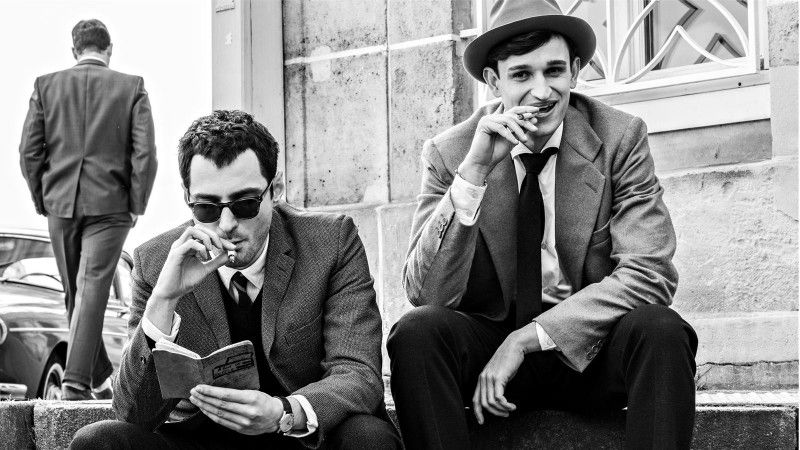
The stylistic choice to introduce each New Wave figure with a name-card and a half-body shot is no less effective than just presenting the large ensemble through the standard narrative. Every character is at best a caricature of these titans in filmmaking, with quippy one-liners dropped constantly throughout, and a distinct lack of substance for anyone outside of Jean Seberg or Jean-Luc Godard.
The black and white cinematography is gorgeous, well-framed, and excellent throughout. The editing suffices for the story Linklater is interested in telling, even if it says nothing worthwhile. My muted reception to narrative, thankfully, was brought up so heavily by the craft of film.
I do wish I loved the film. It is a rare Linklater miss for me, a lover of his filmography and a love of the French New Wave. Funnily, the other four critics I watched this film with all came out positive on the movie, with me being the only dissenting opinion. I don’t think either loves Linklater or New Wave as much as I do; our debates on the film made me happier by the end of the day.

2.5/5 stars

 From the Fourth Row!
Leave a comment