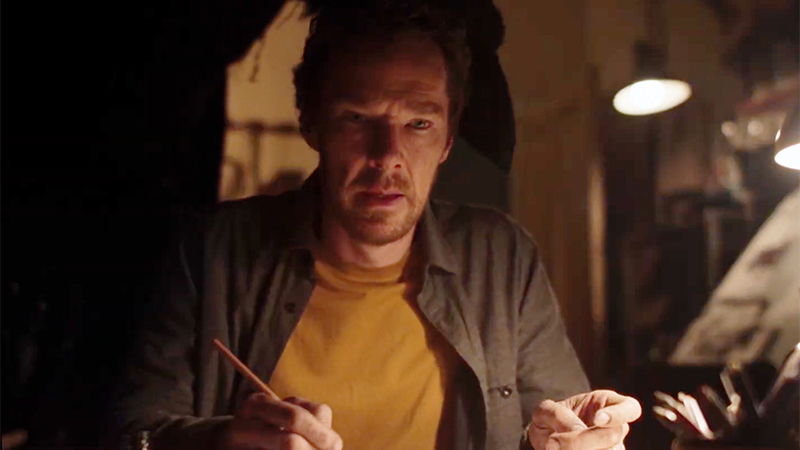

Grief is a popular topic in Hollywood. There have been many movies and television/streaming shows about death and dealing with the consequences and the results of dying in various ways. The latest movie about that topic is “The Thing With Feathers” based on the book “Grief is the Thing with Feathers” by Max Porter. All of the many stories about this topic are handled in very different ways by the filmmakers and screenwriters who have tackledthis topic. This one is no different than the others. The writer/director Dylan Southern takes a very circuitous path while making this film. It’s not exactly the route I would have expected given the subject matter. Alas, it’s based on the book, so he had to stick to the text.
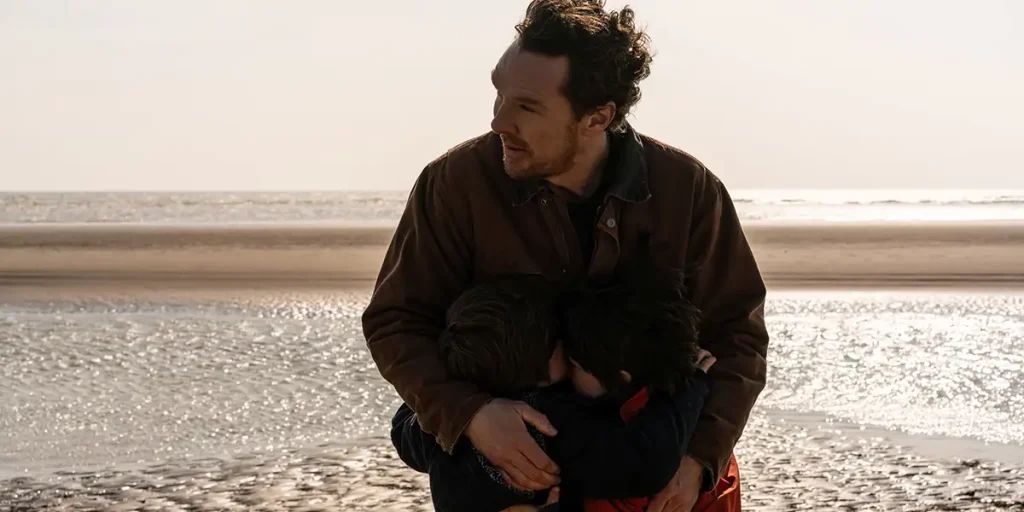
In England, Benedict Cumberbatch plays a father with two boys (Henry & Richard Boxall) who are dealing with the death of their wife/mother from a sudden cardiac arrest. This comes as a shock to the family as she was the glue that held this family together. The father had to try to keep the family together despite the tragedy. He tries to keep the same routine for his boys as before. They get up, have breakfast, and go to school, allowing him to do his job as an artist. While their he breaks down because he didn’t expect to be in this situation, he found himself in. He turns to drinking, but that doesn’t stop him from having flashbacks and dreams about his wife and what happened to her. His grief manifests itself in a strange way, though. He starts hearing a voice in his head and eventually sees a large crow. This makes him think he’s crazy.
This film uses chapters as a way to help differentiate the different segments of the story. The first is called “Dad”. It mainly deals with the fathers grief and how he tries to cope with the loss of his wife and mother of his children. As well as suddenly having to take care of two adolescent boys on his own now. The second chapter is named “Crow”, and deals with how the family, including the boys, manifest their grief in the form of a giant talking crow voiced by David Thewlis. The voice is dark and brooding and doesn’t sound anything like Thewlis normally sounds. The voice was clearly augmented for this character. David Lamaert plays the man in the crow costume, and he’s quite menacing to look at. The combination of Thewlis and him create quite the imposing character. The third chapter is called “The Demon” because of another idea the movie is trying to push on viewers and the characters. I can’t say much about this because of spoilers.
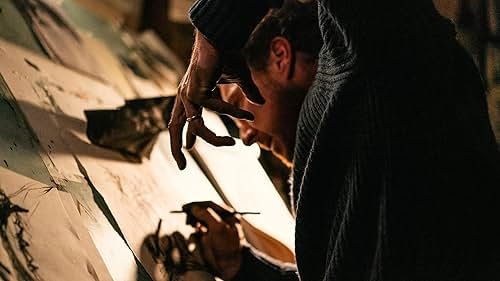
There are a few things that sucked me into this story. First and foremost, the Cumberbatch character is an artist of some kind as his profession. He has a drawing board up in his study or attic. He draws what he starts to see in his head, and they are pretty disturbing pictures of crows. And the violent things they are doing. At one point, he is dictated by the crow itself to keep drawing and painting crows on his board. This is the start of his mind going somewhere, but who knows where. The drawings, flashbacks, and dreams all combine to help push this man into some state of insanity. He has to fight his better judgment to stop from going completely mad. That allows him to try and help his boys before they get completely sucked into the madness as well. If he didn’t have them, he may have succumbed to the madness all of this is causing him.

With any picture, the technical aspects play a part in whether a movie is good or bad. This one is another one that has some interesting technical elements that help the film. First is the score by Zebedee C Budworth. The score is very moody and atmospheric in nature.With the brooding nature of the story, the dark score plays right into the whole concept of the movie. The second element I want to talk about is the cinematography by Ben Fordesman. Its very dark most of the time. Especially the further along the film goes. Towards the end, though, he uses more blue, red, and yellow light to change the atmosphere. He gives the characters a different perspective to look to. This was some very interesting camera work from this man who I haven’t heard of before. He is definitely someone I’m going to keep my eye on in the future. He has potential as a great cinematographer in the future. These two aspects of the movie help give it the vibe the filmmaker was looking for.
The performances from Cumberbatch and the two boys were good but not great. There were many moments when I was locked in to what Cumberbatch was doing as this character. I couldn’t imagine what he’s going through, but I have a friend who went through a similar circumstance very recently, and he chose to use his family and god as a solace for his grief. The boys who I haven’t seen in anything before were also good and did what I would imagine kids would do at this age given the situation they were thrust into. A life without a mother and a father who is a bit overbearing because of alcohol and his own mental issues. As a cast I’ve seen better, but this trio wasn’t bad at all. I was glad to see Cumberbatch doing different kinds of roles other than Doctor Strange/Steven Strange.
I’ve dealt with my fair share of death in recent months. My father died at 87 years of age two months ago, and a few close family friends have recently passed away in the last year. So, this story is one I could relate to. In a way. I love how writers can be so creative in telling stories. Sometimes, though, creativity can go a little too far.I think that’s the case here. Not that I totally don’t like this film, because I do. I just think the manifestation of grief in the form of a crow is a little far-fetched. Even for my liking. Obviously, this movie is based on the book, but even that is a bit out there. “The Thing With Feathers” has some good ideas, but I don’t think they are fully realized in this film. In fact, I would go as far as to say they may be a little too much for the average audience to comprehend. Most film aficionados probably have seen all kinds of stories like this. So it’s not as jarring for them as it would be for many viewers from my perspective.I always give filmmakers the benefit of the doubt, though, and say good try and lets get ’em next time. To use a sport analogy.
2 ½ stars
Dan Skip Allen

 From the Fourth Row!
Leave a comment