

By Fiorela Gonzales
Greenland 2: Migration is the sequel to 2020’s Greenland, which was an unlucky victim to COVID. The original movie got pushed around and delayed until it was inevitably dropped on video on demand and streaming. It may have just been living through the pandemic, but an extinction level asteroid destroying Earth felt like a respite at the time, and that movie came as a pleasant surprise. Fun, exciting, a bit predictable, but kept you thrilled enough as John (Gerard Butler), his wife Allison (Morena Baccarin), and their diabetic son, Nathan (Roger Dale Floyd) did everything they could to get to the underground bunker in Greenland before the asteroid hit.
The original movie ends with them making it to Greenland, family, and insulin intact (the diabetes of the son being a big plot point of the original movie). Then, after 9 months underground, they open the bunker doors, and there’s sunshine, and a bird flies by. That hopeful ending always felt unreasonable as they mention that the asteroid that hit Earth was larger than the one that destroyed the dinosaurs, and if you have any basic knowledge of extinction events such as those, you know that the world is uninhabitable for generations following the fallout of such a hit. Well, if that sunshine and bird at the end of the first movie was unreasonable, they completely doubled down on it for the second movie that can quite literally only work if you completely assume the world is apocalyptic due to any other reason besides an asteroid.

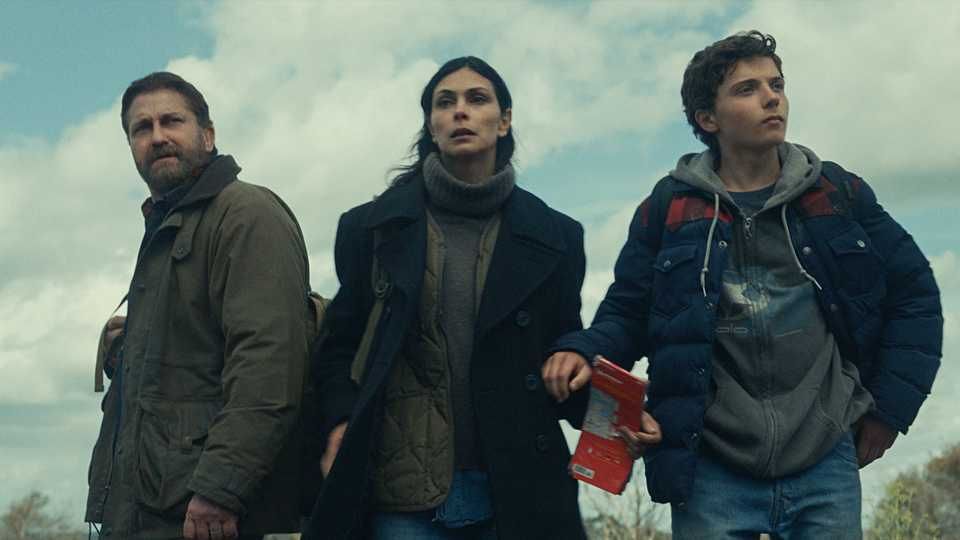
In this new film, John, Allison, and Nathan (now played by Roman Griffin Davis) have to leave the bunker due to it crumbling from the shifting of the tectonic plates. Fortunately, they manage to jump on a small sub type ship (filled with gas) that has floated up on their shores. The gas does eventually run out, so they have to float via the stream and hope the small amount of rations (which they somehow have even though they all had to evacuate so quickly) doesn’t run out. Fortunately, the ship lands in Liverpool – just from floating downstream. Society seems to still exist with humans living and buildings existing for the most part, and fortunately, they find a man with a car that somehow has gas to drive them to London. And fortunately, they have a friend (never mentioned how or why they have this connection) who lives in a hospital in London that comes equipped with Christmas lights and wine that they can spend the night at. Now, the big plot of this film is that the epicenter of the crater that hit has become some sort of Eden where nature flourishes and the water is drinkable. The crater is located somewhere in France, which is impossible to get to because it’s in the middle of a warzone. (Machine guns survived the asteroid). So, the friend in the hospital lends them her car, fortunately filled with gas, to drive to France. Some things occur during their travels, and none as thrilling as the events from the first film, until they meet up with a French man who, fortunately, lets them stay in his home. A home that, somehow, has food, water, books, and just full furnishings. This man is living like it’s 2019. Fortunately, this man has a 15-year-old daughter for our lonely 15-year-old, diabetic son Nathan. (Wait, is he still diabetic? It hasn’t been mentioned even though it was the biggest issue of the first movie.) And fortunately, this French man has a connection within the French army who will then take John and his family safely across to the crater. What will happen, I wonder?

Suffice to say – things are working out very easily for this family in this apocalyptic world. The stakes aren’t very high, and everything functions pretty well, considering an asteroid, bigger than the one that killed the dinosaurs, hit the Earth. And I don’t want to get too pedantic, so let’s accept the fact that humans, buildings, food, resources, wine (?), machine guns and all the jewelry that the female characters are wearing survive – but I draw the line at there being usable gasoline for multiple vehicles. This family used boats, cars, and buses – all fully filled with gas – to make it to their destination. You really have to have zero knowledge of post-apocalyptic worlds to make it to the end of this movie without actively laughing at the lack of plausibility. Allow yourself to believe that they’re in this situation due to maybe… global warming and famine. At least this allows plausibility for these characters to exist in these situations. Not to mention that a big plot of this movie is that air is unbreathable, which is something they also forget about as the masks are dropped early on and never really mentioned again.
Overall, Greenland 2: Migration takes the biggest failure of the first movie (opening the bunker door to sunshine and birds) and makes a movie so implausible you have to imagine a completely different world within it. The stakes are low, and though things happen to this family, nothing really ever actually happens until the mandated emotional manipulation scene. Interestingly enough, the title drop during the movie is “Greenland: Migration” with the 2 conveniently missing. It’s almost as if they, too, want you to forget the facts from the first movie (deep impact and diabetes) so they can make this movie work within a new world. Fortunately for the characters, this world does work for them. Unfortunately for the rest of us who have sat through this, we all have functioning brains. At least it’s only 99 minutes.
1 ½ stars
(2 if you pretend the extinction asteroid wasn’t the impetus for the post-apocalyptic world)

 From the Fourth Row!
Leave a comment