

By Fiorela Gonzales
When thinking about Catherine O’Hara, so many of her iconic roles immediately jump to mind. Her decades-long collaboration with Tim Burton through Beetlejuice, The Nightmare Before Christmas, and more recently, Beetlejuice Beetlejuice. The mom we thought was ours too when we were growing up with Home Alone and Home Alone 2. Countless 80s and 90s comedies that she made her mark in. And though she was never gone, she had an acclaimed resurgence in 2015 as Moira Rose in the Emmy Award winning show, Schitt’s Creek, for which she won numerous accolades including an Emmy and a Golden Globe. Everything she touched turned to comedy gold, and that is especially true of her work in the little forgotten 2006 film, Penelope.
Penelope is a fantastical romantic comedy starring Christina Ricci as the titular Penelope, who due to a curse placed upon her ancestors, is born with the face of a pig. Though she’s meant to be hideous, Christina Ricci is unfortunately so beautiful that even with a pig snout it’s hard to believe anyone could think of her as anything less than beautiful, but I digress. The only way to break the curse is for someone of blue blood (like her family’s nobility) to fall in love with her as she is. Fearing public scrutiny, and a very nosy reporter (played by Peter Dinklage), Penelope’s mother, Jessica, decides to fake Penelope’s death and keep her hidden inside. Jessica is the one played by Catherine O’Hara who gave an all-time performance as the overbearing mother who means well, but ultimately causes more stress and havoc for Penelope.

Jessica hires a matchmaker to find a suitor of blue blood for Penelope so they can lift the curse. Edward (Simon Woods) is one of these noble types who sees her “hideous” face and immediately runs away. Their butler Jake (Michael Feast), who is in charge of catching all the suitors from running, loses him and Edward goes to the press claiming the existence of a horrible pig woman. The very nosy reporter, Lemon, who had been looking to prove her existence since the faked death, decides to team up with Edward. They hire Max Campion (James McAvoy), a down on his luck man who gambled away most of his family’s fortune, to pretend to be a suitor and get a secret photograph of Penelope. Max and Penelope hit it off and when he sees her face, he doesn’t run, but he declines to marry her. Penelope, heartbroken and realizing that her mother will never stop, runs away. To her surprise, people accept her out in the world and she becomes a celebrity. Edward still finds her a hideous beast and says so to the press, so his father who makes the ever-prescient statement, “we are a publicly traded company, we like what the public likes”, coerces Edward to propose to Penelope due to the public’s fondness for her.
At the wedding, Penelope rejects Edward and runs away. As Jessica pursues her and begs her to stay so she can marry Edward and finally be happy, Penelope declares that she likes herself the way she is. This breaks the curse. Ends up she had the power within herself all along; she just had to accept herself – as she is of blue blood herself. We learn that Max only rejected Penelope because he was not actually a blue blood and had pretended so he could take the money and therefore had no power to break the curse. Penelope and Max end up together and it’s a beautiful, albeit a bit cheesy, magical ending.
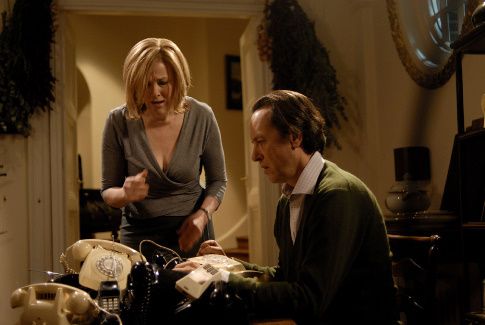
The movie is lovely, and not just because of the magic and romance, but because of the way it lives inside a timeless London. It’s clearly modern times, but not precisely, based on the cars on the street. There are no modern phones, instead they all speak through pay phones and rotary phones. The reporters all work on typewriters. You’re in this world that exists primarily for this movie and that makes it more magical than the actual magic of the curse does throughout the movie. It’s also so colorful and bright. (Something modern movies seem to have forgotten you’re allowed to do.) Penelope’s room in particular, a place she lived in for 25 years, is so uniquely decorated that it feels like a fairytale room existing in the real world.
The movie is also very funny and a lot of that is thanks to Catherine O’Hara. No line she says in this movie goes to waste. She had such a way to create a character that was so specifically hers that no one else could recreate. “Mom that wants her daughter to marry” is not uncommon trope and yet, Catherine O’Hara did what she’s always done to every role she’s ever done, which is make it so uniquely her and so uniquely funny. There’s a lot of other funny characters throughout the film, including Richard E. Grant as the father and Reese Witherspoon as Penelope’s friend, but Peter Dinklage’s “nosy reporter” is also giving a top tier performance. Especially as Peter Dinklage and Catherine O’Hara go head-to-head as the “reporter vs the mom who buried the not-actually-dead daughter”. Important to note: Peter Dinklage is wearing an eyepatch for the entire film because Catherine O’Hara’s character smashed out his eye with a meat cleaver in the first 10 minutes of the movie. An underrated Peter Dinklage performance, but a perfectly rated Catherine O’Hara performance because she’s never been anything less than amazing in every role she’s played.
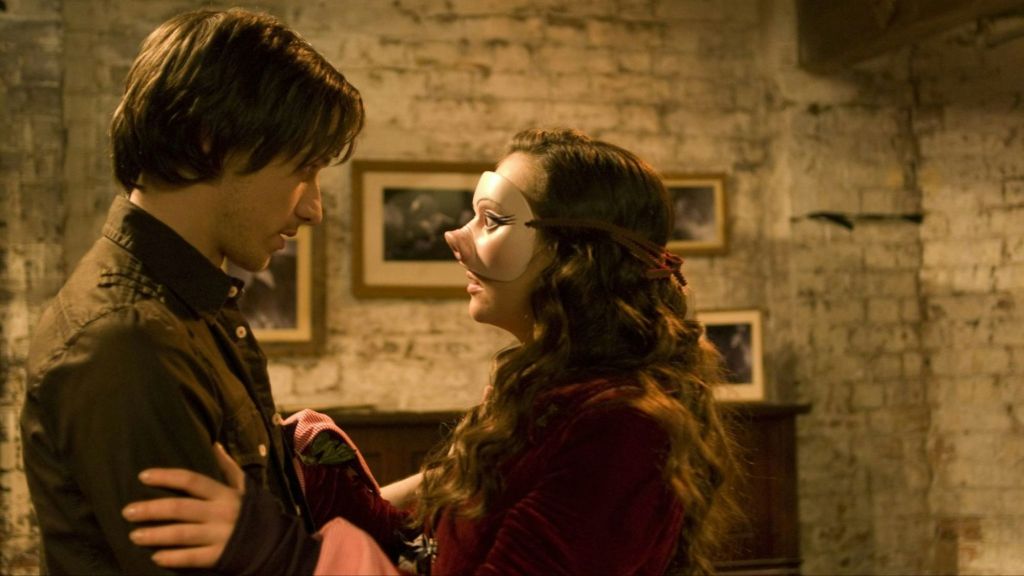
Penelope is a funny and feel-good movie. It’s magical and romantic and lives inside such a beautiful world that you’re happy to be part of it for a little under 2 hours. There is really only one downside to this film and it’s a surprise appearance from Russell Brand. At the end of the movie, there’s also a little plot twist that the butler Jake was actually the witch that had originally placed the curse on the family. The movie ends with one last comedic bit as Jake/the witch takes away Jessica’s ability to speak. In these last moments of the film Catherine O’Hara is mute, but it only makes her funnier. Only she could say no words and use her entire body to convey the joke. Which maybe is an apt metaphor for a future without Catherine O’Hara, where we’ll no longer hear her voice – but her comedic abilities will live on in everything she touched.
4 stars, 5 for Catherine O’Hara.

 From the Fourth Row!
Leave a comment