
By Fiorela Gonzales
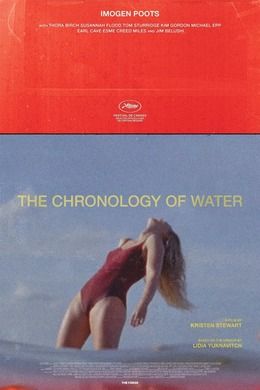
Almost two decades after Kristen Stewart became a household name for a tentpole blockbuster franchise, she has proven that she’s anything but a cliché. Kristen Stewart has carved her own way in Hollywood and, on the way, has become one of the most interesting working actors today. She has never shied away from the uncomfortable, and now, with her feature film directing debut of “The Chronology of Water”, she’s shown that she has no intention of going back to the beaten path.
This film is based on the real-life story of American author Lidia Yuknavitch and the memoir she wrote of the same name. The movie follows Lidia, played by Imogen Poots, as she survives an abusive childhood at the hands of her father in the 1970s San Francisco and her fight to leave as she pursues her passion for swimming. Though she manages to escape and get a scholarship swimming in Texas, the terrors of her past are never too far behind her. Lidia struggles with drug and alcohol addiction, losing her swimming scholarship and finding herself cast out and broken. Though Lidia fights demons and trauma throughout, she eventually finds solace in being a writer and professor, ending the movie on a surprisingly uplifting tone.
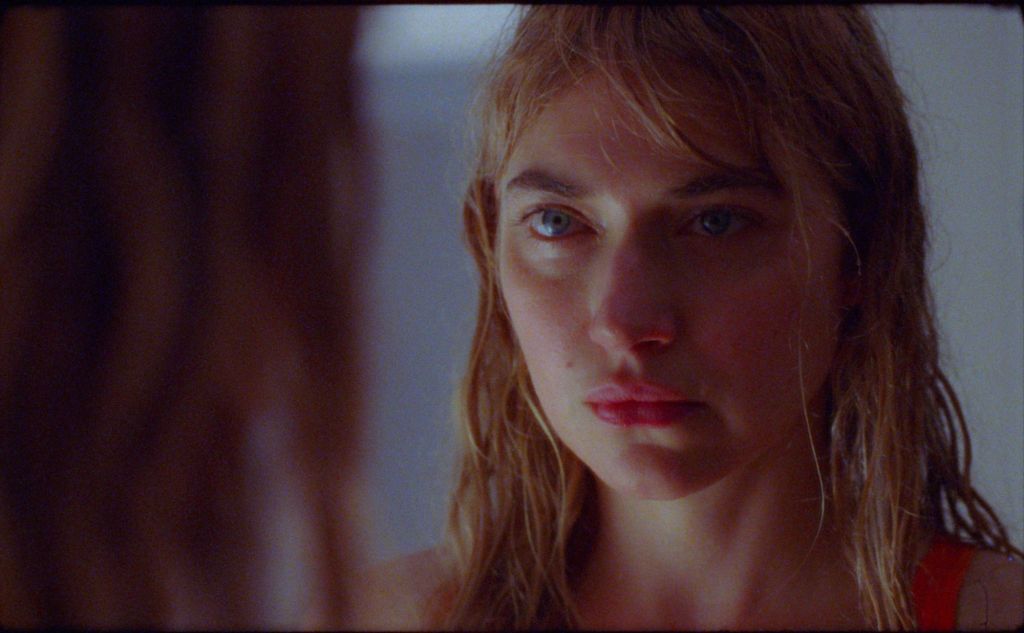
Kristen Stewart has this filmed under a microscope. Close ups take heed for the majority of the movie as she rarely lets you out to see the world around. She shows you everything you need to see, and nothing you don’t. There is so much violence against women in this story and Kristen Stewart shows you none of it while making you feel all of it. There’s one specific shot I can’t stop thinking of where we see the reflection of Lidia’s father through Lidia’s eye. It’s intimate and frightening and beautifully shot. Stewart balances trauma in this movie through the use of blood and water. Blood shows up often and everywhere, from Lidia’s own body to that of a small trophy. It’s counteracted with water, which acts as Lidia’s escape. Even when she no longer swims, the water surrounds her – even if only in her mind. The film itself starts with blood flowing down the shower drain mixing with water, which ends up being the essence of the film: the pain is always there, mixed in as part of you, no matter how hard you try to swim past it.
Ultimately, Lidia finds solace past the water and in words. Though for a movie about a woman finding her strength through her words, it doesn’t seem too concerned with its own words. The story is told primarily through visuals, and the narration takes a backstep to it. Imogen Poots narrates Lidia’s words in a quiet mumble that feels almost as if she’s talking to herself, and we’re not supposed to hear it, but feel it instead. And though we definitely feel it, primarily thanks to Stewart’s direction, the mumbling monologue does itself a bit of a disservice.

As I haven’t read the book that this is based on, I can’t compare it to the source material, but the movie flows through Lidia’s short stories, weaving what you assume happened and what she’s telling you happened. At one point in the film, Lidia states to herself “I am a woman who talks to herself in lies.” And since these are her narrations, we do wonder if what we’ve seen has been the whole truth. Even the title of the film speaks to this notion. A chronology insists that things move in a specific order, something that is the antithesis of water, which flows freely through everything. Much like water, these stories can’t be arranged and never give us the full picture. But they give us enough.
Women’s bodies take a forefront in this film as Stewart films them with such love and attention. They are the main event of this movie, which is why the ending, though uplifting, came as a surprise to me. Ultimately, Lidia ends up with a man, and though a great man, I’m sure, we never learn too much about him. He comes around at the end once Lidia seems to have found her stability, and the same care and dedication that Stewart showed with all the women in the film is missing here. The men are the few characters in the film that are filmed in wide shots, so it always feels less intimate. (Which is by design, I’m sure.) But what we end up with is a man we don’t know much about becoming part of our hero’s endgame. I wish we had learned just a little more about this man because by the end of the 2 hours you’ve lived through 30 years of Lidia’s trauma, and we want her to be happy, but now we’re protective as well and want to know who this man is. We’re all the older sister by the end.

It’s hard to watch movies with such excessive traumatic content like this one, but Stewart has such a graceful hand that you never feel violence just for violence sake. She doesn’t hold back, and she doesn’t shelter us, but she still allows us to be part of her character’s pain. “The Chronology of Water” is an impressive directorial debut by Kristen Stewart, and I look forward to seeing where her off-the-beaten path journey takes her next.
3 ½ stars.


Leave a Reply